For and Against — chapter 2 of Jules Verne's Twenty Thousand Leagues Under the Sea, told in clear English for language learners.
- Episode
- 02 / 27
- Level
- B1–B2
- Length
- 00
Listen and read
Transcript
For and Against
The current word is highlighted as you listen. Click any word to jump there.
Chapter Two — For and Against
My name is Pierre Aronnax, and in the spring of 1866 I was staying in New York — right in the middle of all the excitement.
I was a professor of natural history from the great museum in Paris, and I had just come back from six months studying rocks, plants, and animals out in Nebraska. My bags were full of treasures, and I was only waiting for May to sail home to France. But like everyone else in the city, I could think of just one thing: the monster.
I had read every newspaper, American and European, again and again, and I still couldn't make up my mind. Some days I was certain the creature was real. Other days I thought the whole thing must be nonsense. But there was one fact nobody could argue with. If you didn't believe in the monster, you only had to go and put your finger in the hole it had punched through the Scotia.
By the time I reached New York, people had given up on the silly explanations. A floating island? A drifting sandbank? Those couldn't race across the ocean in three days. A giant sunken shipwreck, bobbing about? No. That left only two real possibilities.
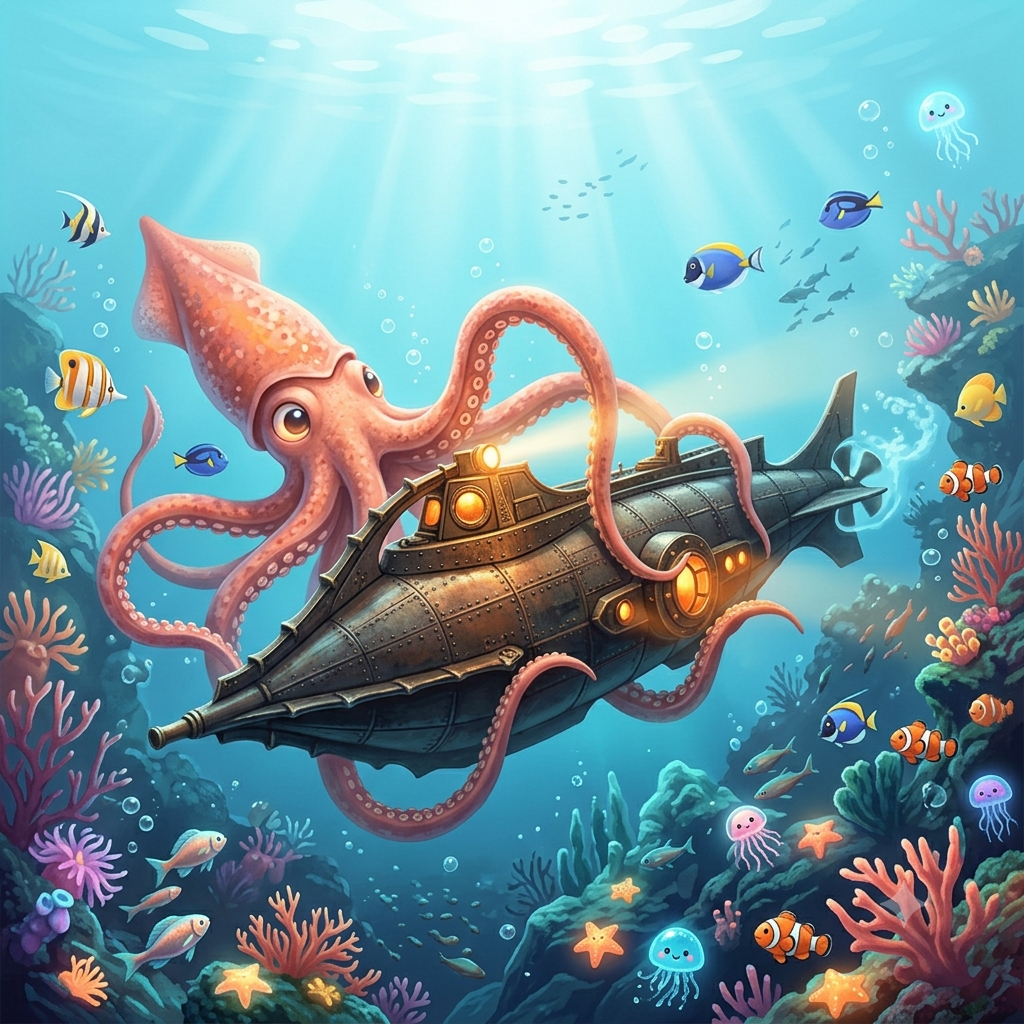
Either it was an animal of tremendous strength — or it was a submarine, a boat built to travel underwater, driven by some enormous engine.
The submarine idea was clever, but it fell apart the moment you thought hard about it. Who could build such a machine in secret? Not one man on his own — where would he hide all that work? And not a government either, because rival countries watch each other far too closely to miss something so big. No, a secret submarine was impossible.
So it had to be an animal. And people wanted to know what I thought.
Now, I had once written a book about the deep sea, so my opinion carried a little weight, and I gave it carefully. The deepest parts of the ocean, I explained, are a complete mystery. No rope is long enough to measure them. Down there, miles beneath the waves, creatures might live that no human has ever laid eyes on. Perhaps our monster was one of them, carried up to the surface by some rare accident.
But if not — if it was a creature we already knew — then I had a guess. I believed it was a narwhal.
Have you ever seen a narwhal? People call it the unicorn of the sea. It is a kind of whale with a single long tusk of ivory, sharp and hard as steel, jutting straight out in front of it like a sword. An ordinary narwhal can grow sixty feet long. Now imagine one five or ten times bigger, with a tusk to match. A creature like that, charging at twenty miles an hour, could drive its ivory sword clean through the iron hull of a ship as easily as a nail goes through a barrel — exactly the kind of wound we had seen on the Scotia.
My article was printed, argued over, and — I will admit it — it made me rather famous. People love the idea of a great monster, and the sea is the perfect place to hide one.
Soon America decided to act. In New York they made ready a fast warship called the Abraham Lincoln, under a bold officer named Commander Farragut, and loaded it with harpoons and every tool needed to hunt a giant of the deep. But — wouldn't you know it — the very moment everyone was ready to chase the monster, the monster vanished. For two whole months, not a single ship saw it. It was almost as if the creature knew it was being hunted.
Then, at last, news arrived: a steamer had spotted it three weeks earlier, far out in the North Pacific.
Just three hours before the Abraham Lincoln was due to leave the dock in Brooklyn, a letter was delivered to my hotel. It read:
> Dear Professor Aronnax, > If you will join the Abraham Lincoln on this expedition, the United States would be glad to see France take part. Commander Farragut has a cabin ready for you. > > Yours truly, > J. B. Hobson, Secretary of the Navy