A Shifting Reef — chapter 1 of Jules Verne's Twenty Thousand Leagues Under the Sea, told in clear English for language learners.
- Episode
- 01 / 27
- Level
- B1–B2
- Length
- 00
Listen and read
Transcript
A Shifting Reef
The current word is highlighted as you listen. Click any word to jump there.
Twenty Thousand Leagues Under the Sea, by Jules Verne — retold for younger readers
Chapter One — A Shifting Reef
Far out on the ocean, in the middle of the night, a sailor stared at the water and could not believe his eyes.
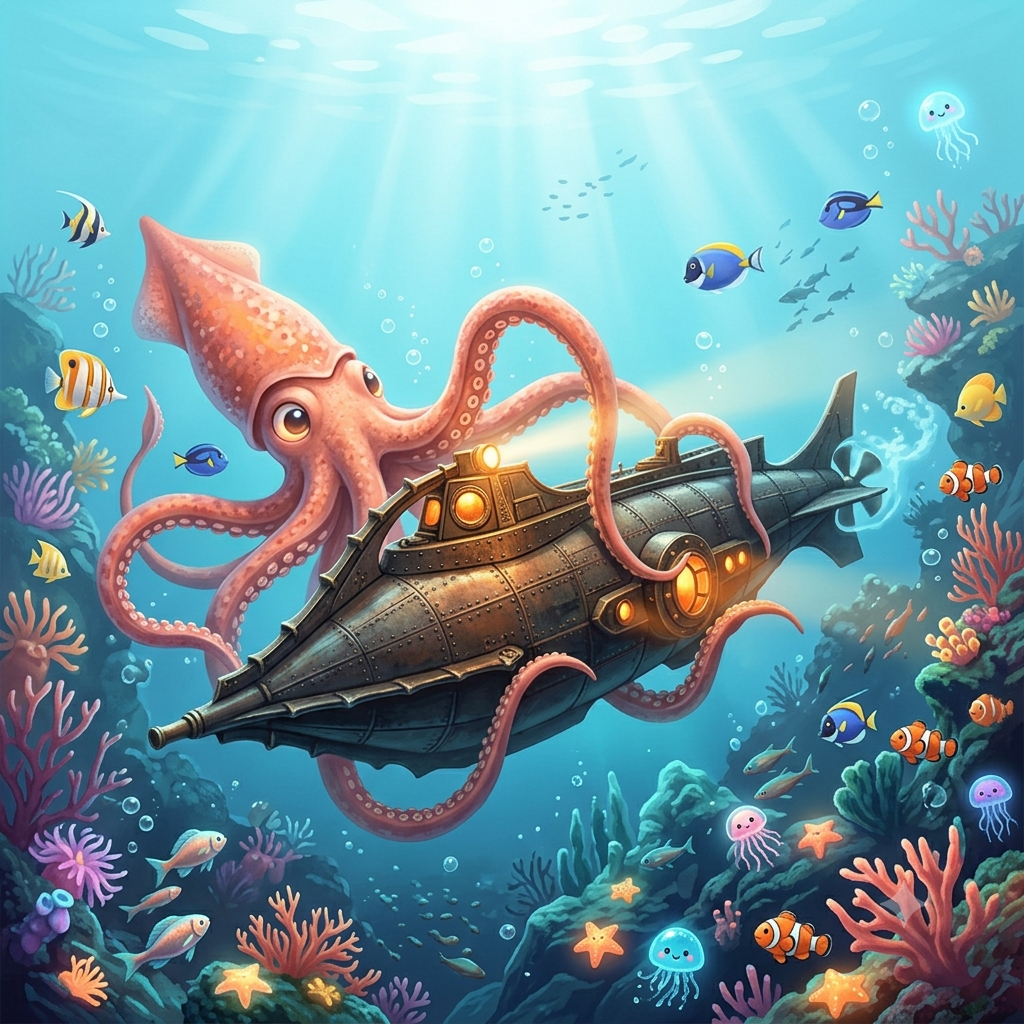
Something enormous was moving beside his ship. It was long and pointed, shaped a little like a giant needle, and it slid through the waves faster than any whale ever could. Now and then it glowed, giving off an eerie light in the dark. Then, just like that, it was gone.
This was the year 1866, and that sailor was not the only one. All across the world, ships were meeting the same strange thing.
At first, people tried to explain it away. Maybe it was only a very big whale, they said. But the biggest whales anyone had ever measured were about sixty yards long — and this creature seemed far, far bigger than that.
On the 20th of July, a steamship called the Governor Higginson spotted it off the coast of Australia. The captain thought he had found an unknown sandbank — until two towering jets of water suddenly blasted a hundred and fifty feet into the air, hissing as they went. Sandbanks don't do that. Whatever this was, it was alive.
Three days later, and hundreds of miles away, another ship called the Columbus saw it too. That was the puzzling part. How could the same creature turn up so far away, so quickly? It would have to swim faster than anything else in the world.
Soon the monster was everywhere — not in the sea, but in people's minds. They sang songs about it in the cafés. Newspapers drew silly cartoons of it. Some people were sure it was a sea serpent from the old legends, or a giant kraken with tentacles long enough to drag a whole ship down into the deep. Scientists argued about it in their journals, page after page, until they were practically shouting at one another. Was it real? Was it a hoax? Nobody could agree.
Then, in 1867, the arguing stopped — because the thing became dangerous.
One night, a ship called the Moravian was crossing the Atlantic when it slammed into something hard in the dark. There was no rock marked on any map for that part of the sea. The ship was strong enough to survive, but when workers later checked her underneath, they found that part of her keel had been cracked clean through.
And then came the Scotia.
It was a calm, beautiful afternoon. The passengers were just sitting down to lunch when they felt a small bump against the side of the ship — not a crash, only a nudge, as if something sharp had poked them. Moments later a sailor came running, shouting, "We're sinking! We're sinking!"
Water was pouring into the ship. When the Scotia finally limped into port and was lifted out of the water, the engineers stared in disbelief. There, below the waterline, was a hole punched straight through the iron hull — a neat triangle, as clean as if someone had cut it with a tool. And that iron was more than an inch thick.
Whatever had made that hole had struck with tremendous force, then pulled itself back out and vanished into the sea.
After that, people stopped laughing. Every shipwreck that couldn't be explained was blamed on the monster. Ships were disappearing, and crossing the ocean began to feel truly frightening. At last the whole world made the same demand, loud and clear:
Someone had to hunt down this creature — and rid the seas of it for good.