Twenty Thousand Leagues Under the Sea · Episode 30
Dashing Through the Mediterranean
Dashing Through the Mediterranean
Dashing Through the Mediterranean — chapter 30 of Jules Verne's Twenty Thousand Leagues Under the Sea, told in clear English for language learners.
- Episode
- 30 / 27
- Level
- B1–B2
- Length
- 00
Listen and read
Transcript
Dashing Through the Mediterranean
The current word is highlighted as you listen. Click any word to jump there.
Chapter Thirty — Dashing Through the Mediterranean
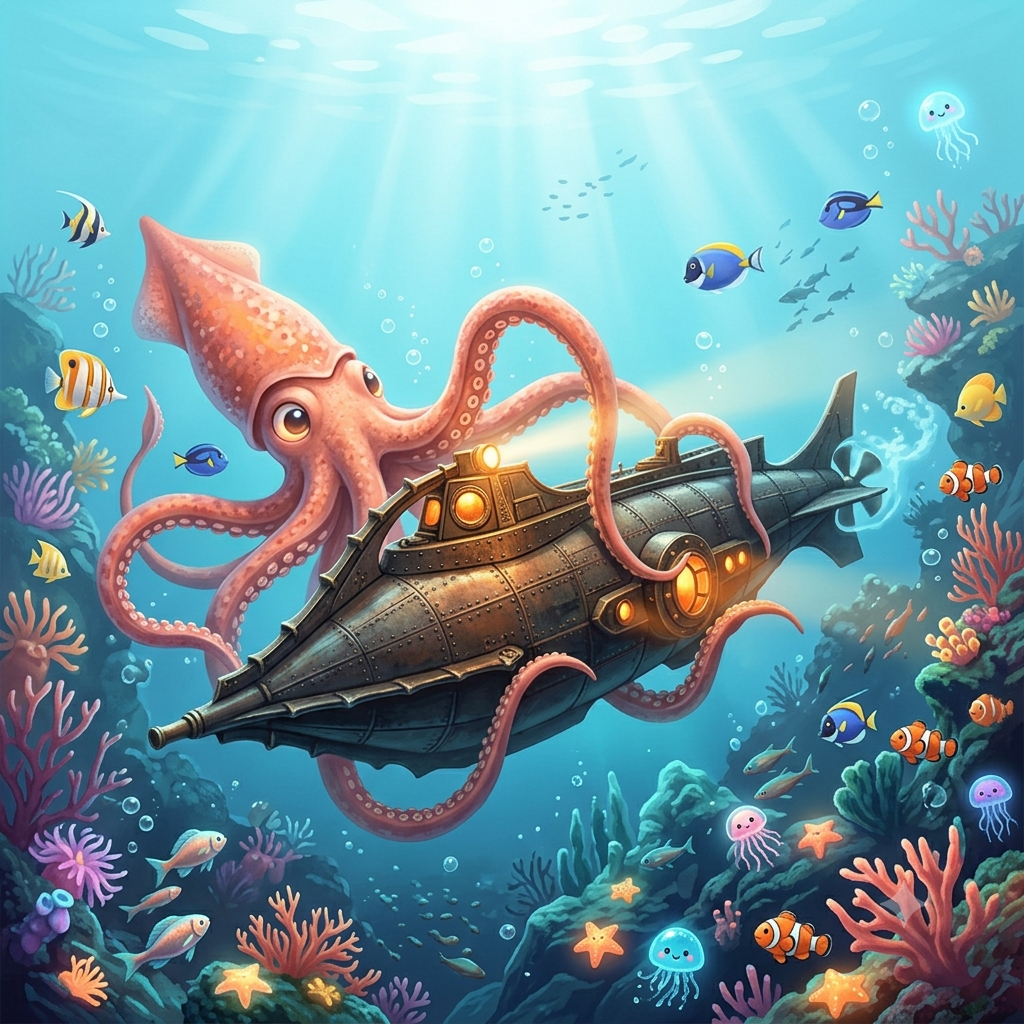
The Mediterranean Sea is a place of great beauty. Orange trees and mountains line its shores, and the air smells of sweet plants. It is a sea full of old history, and once it was full of danger too. But we were only passing through. Captain Nemo's submarine, the Nautilus, moved fast through its waters.
We began our trip on February 16th, near Greece. By sunrise on the 18th, we had crossed the narrow Straits of Gibraltar at the far west. We travelled about six hundred leagues in just two days. The Nautilus went twenty-five miles an hour. During the whole fast trip, Captain Nemo never once appeared. I think he did not like this sea, closed in between Africa and Europe. It brought back too many sad memories for him, and here he was not free.
Ned Land, the Canadian with us, was very unhappy. His plan to escape was now impossible. The Nautilus moved much too fast. Trying to launch a small boat at such speed would be as foolish as jumping off a fast train. We rose to the surface only at night, to take in fresh air. The ship was guided by compass and log.
I saw little of this sea, only what a traveller sees from a fast train — the far horizon, while near things flash past. We passed between Sicily and the coast of Tunis. There the sea floor rose up sharply to make a shallow ridge. The Nautilus had to steer with great care so it would not hit this wall under the water.
I showed Conseil, my helper, the spot on the map. "It is like a bridge of land joining Europe to Africa," he said. "Yes," I told him. "Long ago the two lands were joined here. The same is true between Gibraltar and Ceuta."
"What if a volcano pushed these ridges up above the sea one day?" asked Conseil. "That is not likely," I said. "The fires inside the Earth grow weaker every year. Long ago there were many volcanoes. Now they are slowly dying, and the Earth's heat is fading."
"But what about the sun?" he asked. "The sun is not enough," I said. "It cannot warm a dead body. One day this Earth will be cold and lifeless, like the moon." "In how many years?" "In some hundreds of thousands of years, my boy." Conseil felt better. "Then we have time to finish our trip," he said, "if Ned Land does not stop us first."
During the night the Nautilus slid down into a much deeper part of the sea. On the morning of the 18th, about three o'clock, we reached the Straits of Gibraltar. Here there are two currents. The top one is well known, and carries ocean water into the Mediterranean. The lower one flows the other way, back into the Atlantic. This lower current keeps the sea level balanced. Without it, the rivers and the ocean would slowly raise the sea. The Nautilus used this lower current and rushed through the narrow pass. For a moment I caught a quick look at the old ruins of the temple of Hercules, buried in the ground. A few minutes later, we were floating on the Atlantic.